





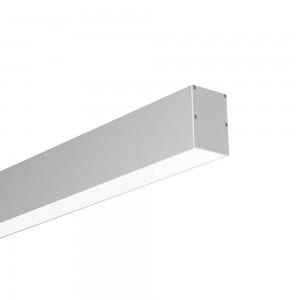
UFO high bays win on ruggedness, efficacy and versatility; linear high bays win on aisle-shaped light, easier service access and lower cost per fitting in low-rack warehouses. Both replace the same 250W–1000W metal halide fixtures at roughly half the wattage — the decision is shaped by your racking, your ceiling and who has to service the fitting ten years from now.
The two form factors, side by side
| Attribute | UFO high bay | Linear high bay (LHB) |
|---|---|---|
| Shape | Round die-cast body with round heatsink fins | Elongated aluminium profile |
| Power range | 100W–300W (X, H03, M, T series) | 100W–400W |
| Output | 13,000–54,000 lm depending on series | 13,000–52,000 lm |
| Efficacy | 130–190 lm/W (H03 reaches 180 lm/W with Philips or SAN’AN chips) | 130 lm/W |
| Optics | 60° / 90° / 120° on H03; 120° standard elsewhere | 120° linear distribution |
| Ingress protection | IP65 | IP54 |
| Drivers | PF ≥0.95 (H03, M, T); Meanwell options | Philips + Meanwell combination |
| CRI | Ra70 standard, Ra80/Ra90 optional (T series) | CRI >80 standard |
| Operating temperature | -40 to +50°C (M series) | Standard commercial range |
| Rated life | 50,000 h | 50,000 h |
Both families hang from the same hooks and wire to the same 100–277V supplies, so switching between them mid-project is not a re-engineering exercise — it is a layout decision.
Where the UFO wins
The UFO’s sealed round body shrugs off dust, forklift brush contact and wash-down better than any linear profile: IP65 across every series, 50,000-hour H03 builds with PF ≥0.95, and an M series that runs from -40 to +50°C for cold stores and unheated plants. The optic range is the second advantage: 60° optics throw useful light down 12-metre racking, 90° covers general distribution floors, and 120° handles low-bay work. In high-rack warehouses the narrow optics put lux onto the rack faces instead of the aisle floor, which is exactly where a picker looks.
Where the linear high bay wins
A warehouse aisle is a corridor, and a corridor wants an elongated light source. The LHB’s 120° linear distribution spreads output along the aisle axis, so fewer fittings achieve uniform illumination between racking runs — and uniformity, not peak lux, is what makes CCTV footage usable and labels readable along the whole aisle. The profile also mounts flatter against low ceilings and services comfortably: open the end caps on a catwalk instead of handling a heavy finned body. In dry, dusty-but-not-washed warehouses (IP54 is enough), it is usually the more economical build.
Converting from HID: both form factors, same rule
| Existing high bay | System lumens | UFO equivalent | Linear equivalent | Power saved |
|---|---|---|---|---|
| 250W metal halide | 16,250 lm | 150W UFO (19,500 lm) | 150W LHB (19,500 lm) | ≈55% |
| 400W metal halide | 26,000 lm | 200W UFO (30,000 lm) | 200W LHB (26,000 lm) | ≈55–58% |
| 400W HPS | 26,000 lm | 200W UFO | 200W LHB | ≈55–58% |
| 600W metal halide | 39,000 lm | 300W M series (42,000+ lm) | 300W LHB (39,000 lm) | ≈57% |
| 1000W metal halide | 65,000 lm | 2 × 200W UFO | 400W LHB (52,000 lm) | ≈55% |
System lumens use the 65 lm/W working figure (ballast losses and lamp depreciation included), consistent with our HID to LED conversion chart.
Decision matrix by warehouse type
| Space | Our pick | Why |
|---|---|---|
| High racking, 10–15 m, narrow aisles | UFO H03 with 60° optic | Narrow beam reaches rack faces; 180 lm/W cuts running cost |
| Distribution centre, 8–10 m open floor | UFO X or H03 with 90° | Even coverage, IP65, PF ≥0.95 |
| Retail back-of-house, 4–6 m | UFO 120° or LHB | Low ceilings, CRI 80 helps product checks |
| Long picking aisles, dry warehouse | LHB linear | Linear spread gives uniformity along the aisle with fewer fittings |
| Cold store, unheated plant | UFO M series | -40 to +50°C rating, 277–480V options |
| Wash-down or food plant periphery | UFO (IP65) | LHB’s IP54 is not sufficient for wet cleaning |
Cost, service and controls: the quieter differences
Purchase price per fitting is close between the two families at equal output, but the installed picture differs. The linear profile mounts faster on continuous rows — fewer suspension points, simpler wiring runs along the aisle — while the UFO’s heavier single body hangs from one hook and suits high ceilings where access is by lift. Service follows the same logic: end caps and replaceable drivers on the LHB versus a sealed body on the UFO, which is why the UFO’s IP65 rating matters even more at 12 metres — anything that has to come down often should not come down at all.
| Factor | UFO | Linear (LHB) |
|---|---|---|
| Mounting effort per row | One hook per fixture | Fewer points for continuous rows |
| Dust/wash-down tolerance | IP65 across the series | IP54 — dry environments |
| Service pattern | Sealed body; rare, lift access | End-cap access from catwalk |
| Sensor integration | Per-project (microwave/PIR options) | Per-project; rows share feed points |
| Cold store suitability | M series, -40 to +50°C | Standard range only |
Whichever family you pick, specify sensors where traffic is intermittent: an aisle that runs 20% output between passes keeps security coverage and takes the biggest second bite out of the bill after the wattage reduction itself. Both families are quoted with sensor and emergency variants per project — send the fixture count and we return the control scheme with the layout.
How to run the selection in practice
Walk the floor with three numbers: ceiling height, aisle width and the wattage of whatever hangs there now. Height picks the optic (60° above 12 m, 90° at 8–12 m, 120° below); aisle width decides UFO-versus-linear — narrow picking aisles reward the linear spread, open floors reward the UFO’s optic range; and the existing wattage sets the conversion target from the HID table above. From there the fixture count falls out of the area-per-fixture figures in our high bay layout guide, and the full range sits on the high bay category page.
One more check before ordering: the electrical environment. The X and LHB families run 100–240/277V; the M and T series extend to 277–480V and 120–347V for North American plants — confirming the supply voltage per zone prevents the classic retrofit surprise of a pallet of 277V fixtures arriving for a 480V circuit.
Linear vs UFO high bay FAQ
Which is more efficient, UFO or linear high bay?
Per fitting, the UFO ranges reach higher efficacy — the H03 series runs at 180 lm/W against the LHB’s 130 lm/W. Per aisle, the linear’s distribution can need fewer fittings to hit the same uniformity, which can even out the running cost. Compare delivered lux per aisle, not datasheet lm/W alone.
Can I use linear high bays in a dusty workshop?
If the dust is dry and light, IP54 is generally acceptable. Where dust is heavy, oily or the floor gets washed, move to an IP65 UFO. If the area is hosed down, neither is the right tool — that is tri-proof batten territory.
Do UFO and linear high bays use the same mounting?
Both hang from hook or ring mounts on the same supplies (100–277V; the M, T and LHB series extend to 277–480V and 120–347V). Existing HID hook heights can normally be reused; check the ceiling height against the wattage table before reusing spacing.
Which one replaces a 1000W metal halide high bay?
Two 200W UFOs (2 × 30,000 lm) or one 400W LHB (52,000 lm) against a 65,000 lm system figure. With racking below, two UFOs aimed at the rack faces usually deliver better uniformity than one centre-point source.
Is CRI important in a warehouse?
For picking and packing, yes more than buyers expect. The LHB’s standard CRI >80 and the T-series Ra80/Ra90 options make labels, grades and damage easier to distinguish; Ra70 remains fine for bulk storage areas.
What about emergency and sensor options?
Both families are available with motion sensors for aisles with intermittent traffic, which is where the biggest second saving after the wattage cut comes from. Specify sensor and emergency variants per project with the fixture count.
Data sources: LOWCLED specification sheets for the X, H03, M, T UFO series and LHB linear series (published on this site’s high bay product pages); HID system-lumen figures per the 65 lm/W working basis consistent with U.S. DOE lifecycle assumptions.
Video: 5 Years warranty IP66 Waterproof UFO LED High Bay Light - LOWCLED
About this LED flood light
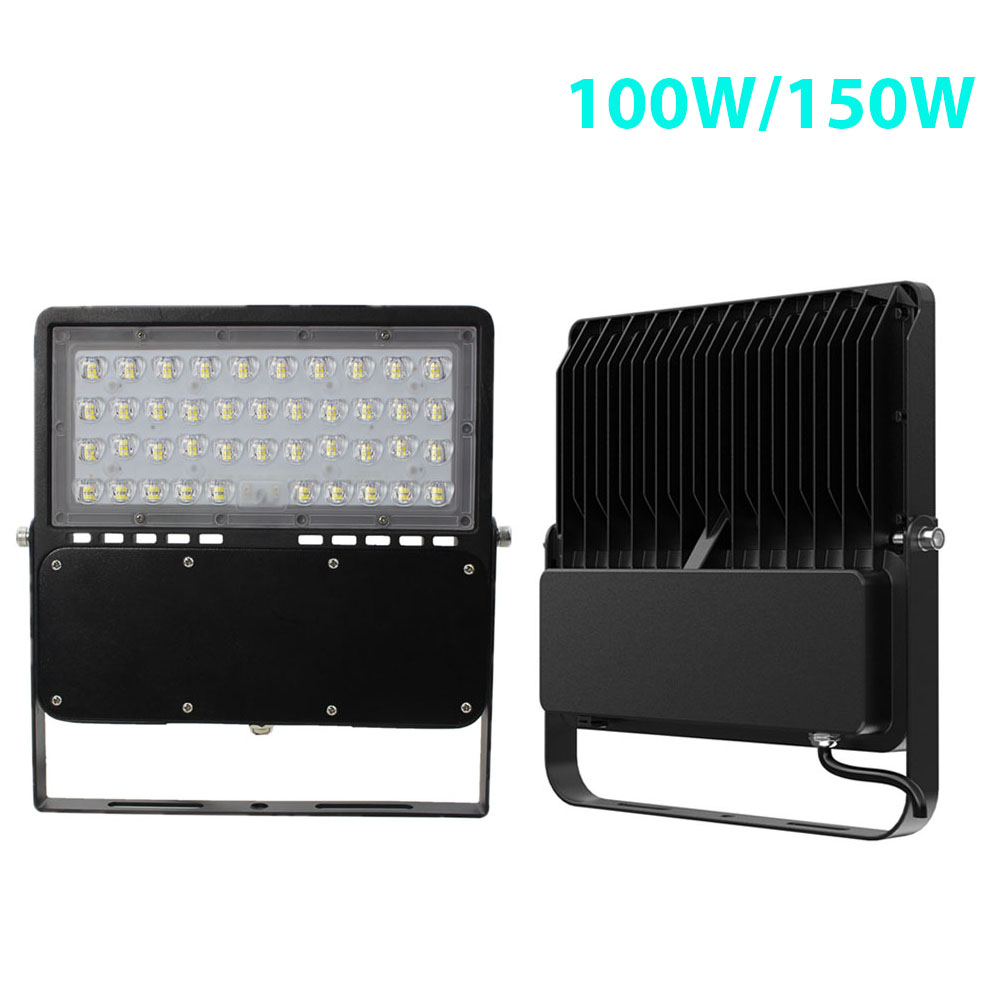
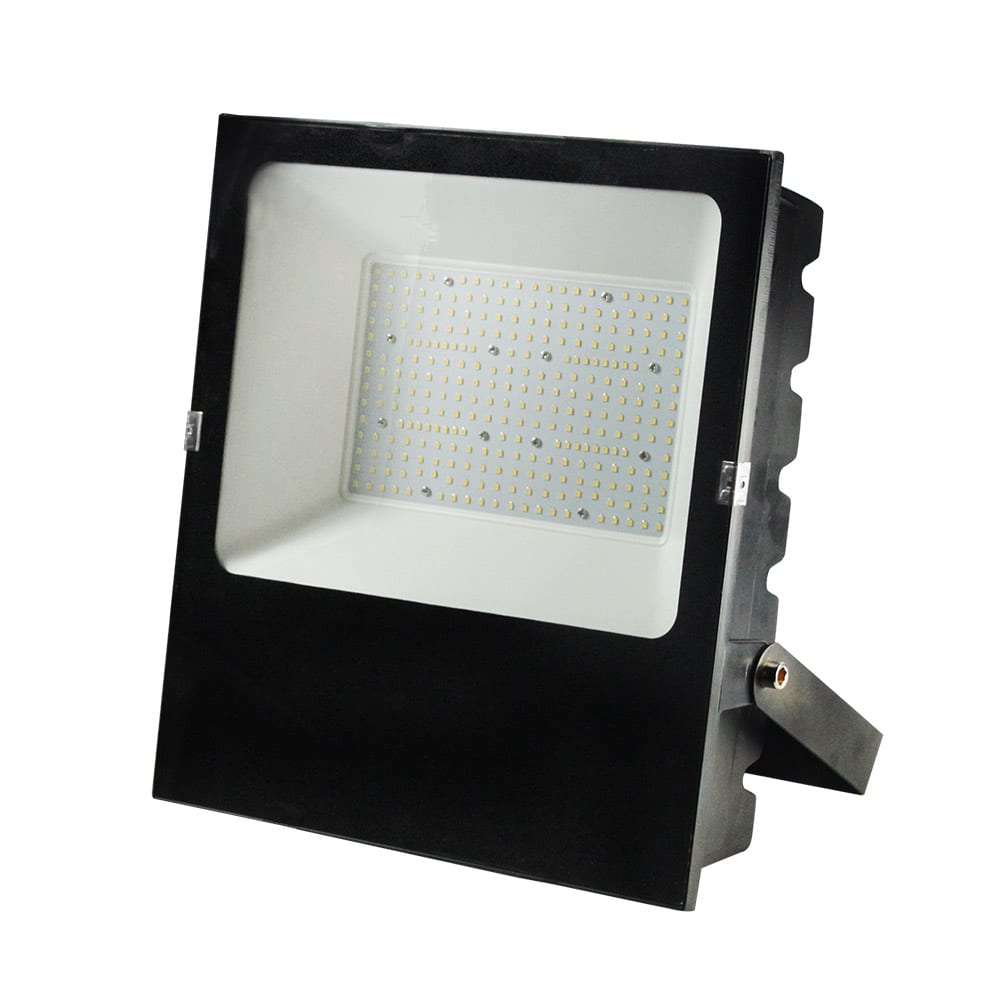
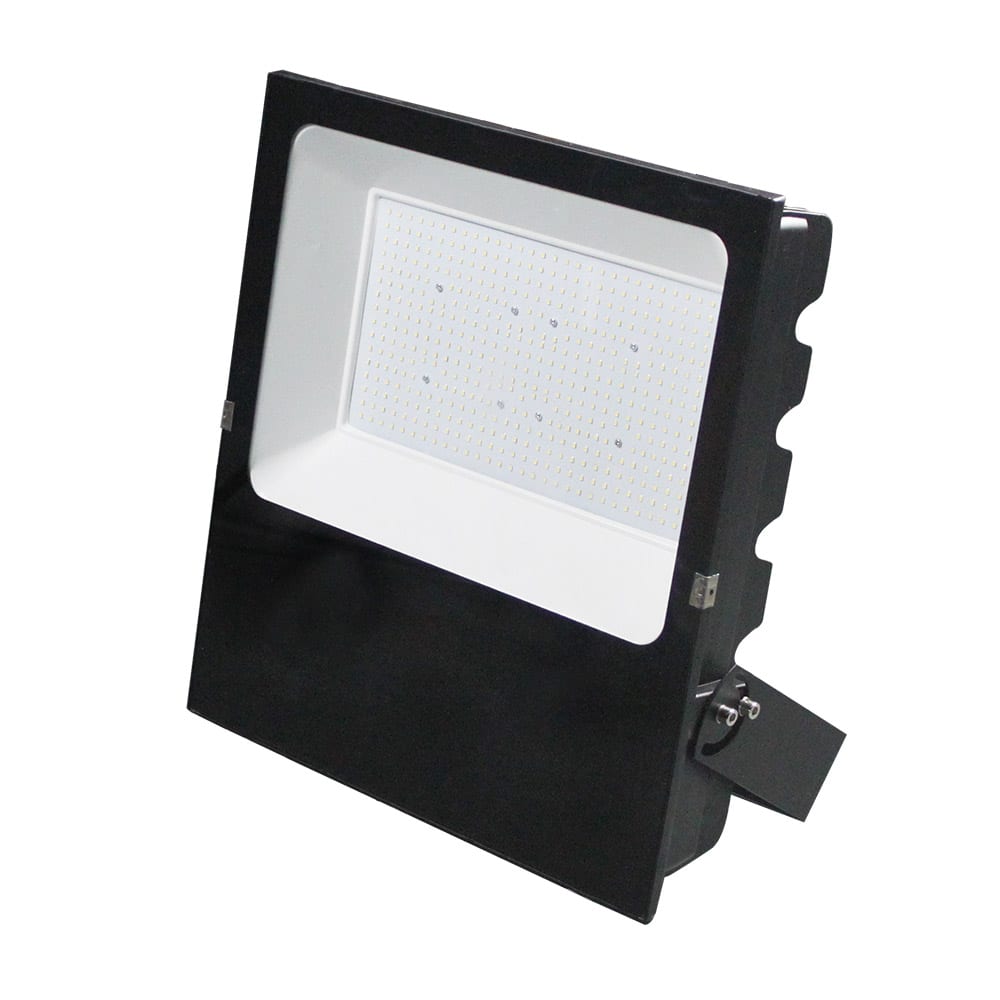
LOWCLED outdoor LED flood lights are built for building facades, billboards, gardens, car parks, sports courts and industrial yards. The 4A / 4S / FLU modular series covers 30W to 2000W with 100-120 degree beam angle, tempered glass lens and a die-cast aluminium heat sink that keeps the LED junction temperature low even in summer.
Every fixture passes a 24-hour aging test and an IP66 waterproof test before shipment. With 150 lm/W, 10KV surge protection and 5-7 years warranty options, they replace 250W-2000W metal halide lamps and cut power consumption by around 70%.
Related products from LOWCLED
Linear High Bay vs UFO High Bay: Warehouse Selection Guide Related Video:
Video: 5 Years warranty IP66 Waterproof UFO LED High Bay Light - LOWCLED
That has a positive and progressive attitude to customer's interest, our organization consistently improves our products quality to satisfy the demands of shoppers and further focuses on safety, reliability, environmental specifications, and innovation of Led Lamp Light, Tube Lighting, Led Stadium Light, Company name, is always regarding quality as company' s foundation, seeking for development via high degree of credibility , abiding by ISO quality management standard strictly, creating top-ranking company by spirit of progress-marking honesty and optimism.